Greta Lange · 1 November 2026
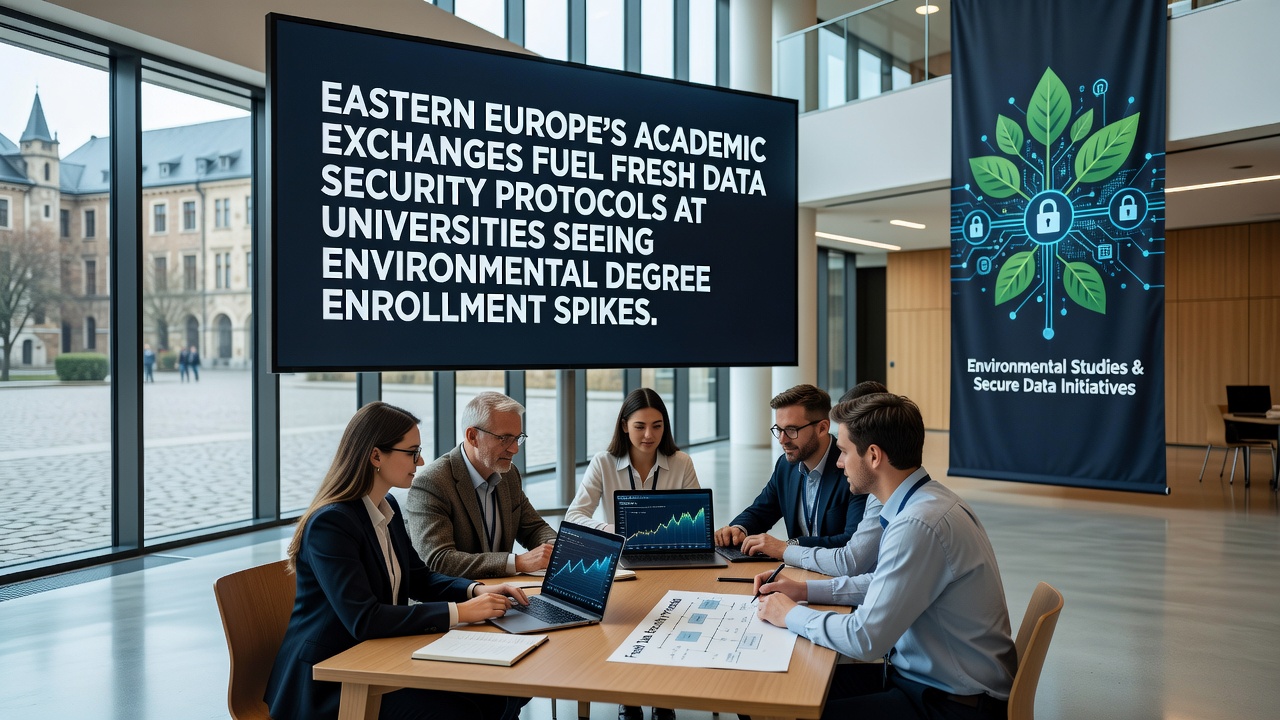
Eastern Europe's Academic Exchanges Fuel Fresh Data Security Protocols at Universities Seeing Environmental Degree Enrollment Spikes
Universities in Eastern Europe continue to record sharp rises in environmental degree enrollments, and academic exchanges with partner institutions have prompted updates to data security protocols that handle sensitive climate and research datasets. These shifts reflect broader enrollment patterns documented across multiple countries since 2023, while renewed exchange agreements signed in late 2025 introduced stricter requirements for cross-border data handling.
Enrollment Trends in Environmental Programs
Figures from national education ministries show environmental science and related degree programs expanding at institutions in the Czech Republic, Hungary, Romania, and Bulgaria, with some departments reporting intake increases between 18 and 32 percent over three academic years. Observers note that these gains coincide with heightened interest in climate adaptation studies and renewable energy policy tracks, and data compiled by the European University Association tracks similar growth in cross-listed courses that combine environmental science with data analytics.
By November 2026, several universities had already adjusted admission targets upward for the following cycle, and administrators cited partnerships that bring visiting researchers from Nordic and Western European programs as one driver behind the sustained demand. Students entering these programs often work with large environmental datasets that include geospatial information, emissions records, and biodiversity inventories, which in turn require updated safeguards during collaborative projects.
Role of Academic Exchanges in Protocol Development
Exchange programs operating under frameworks such as Erasmus+ and bilateral agreements have expanded in recent cycles, and participating universities report that incoming scholars and joint research teams now operate under revised data governance rules. These rules address encryption standards for shared servers, access logging for remote users, and retention schedules for field-collected environmental samples that carry associated metadata.
One study released by the Organisation for Economic Co-operation and Development examined how international mobility affects institutional data practices, and it found that universities receiving more visiting researchers tended to adopt ISO-aligned information security management systems within 18 months of program renewal. In Eastern Europe, this pattern appears in departments that added environmental informatics modules to existing curricula, where exchange participants contribute both data and methodological expectations from their home institutions.

Implementation of Updated Security Measures
Institutions have introduced multi-factor authentication for laboratory information management systems and segmented networks that separate student project files from core research repositories. Training sessions scheduled for incoming exchange cohorts now cover regional data protection requirements alongside institutional policies, and compliance audits occur at the end of each semester rather than annually. These adjustments align with guidelines issued by the European Network and Information Security Agency, which emphasize risk assessments tailored to collaborative scientific work.
Coastal and inland field stations have also revised procedures for transferring sensor data collected during joint expeditions, and technicians route information through approved cloud environments that log every transfer. University IT teams report fewer unauthorized access attempts after these layered controls took effect, although they continue to monitor evolving threats associated with large-scale environmental datasets that hold commercial or regulatory value.
Regional Variations Across Institutions
Differences emerge when comparing capital-city universities with those located near protected natural areas, where local partnerships generate additional data streams that must be secured. In some cases, smaller institutions have pooled resources to share secure storage infrastructure, while larger ones maintain dedicated teams that support both domestic and exchange-related projects. Reports from the U.S. National Science Foundation on international research collaborations note that similar resource-sharing arrangements appear in other regions facing enrollment pressures in environmental fields.
November 2026 data releases from several ministries highlighted that universities with the highest exchange volumes also posted the most detailed updates to their data-handling charters, suggesting a direct link between mobility volume and protocol refinement. These charters now specify procedures for anonymizing location data from endangered species monitoring and for obtaining explicit consent when datasets include community-sourced observations.
Conclusion
Academic exchanges continue to shape data security practices at Eastern European universities experiencing growth in environmental degree programs, and the resulting protocols reflect both regional requirements and international collaboration standards. Enrollment figures through late 2026 indicate sustained interest, while institutions maintain ongoing adjustments to safeguard the datasets that underpin joint research efforts.