Greta Lange · 6 September 2026
Warsaw's AI Ethics Rollout Collides with Eastern Europe's Sliding Academic Freedom Scores and Rising Environmental Science Demand
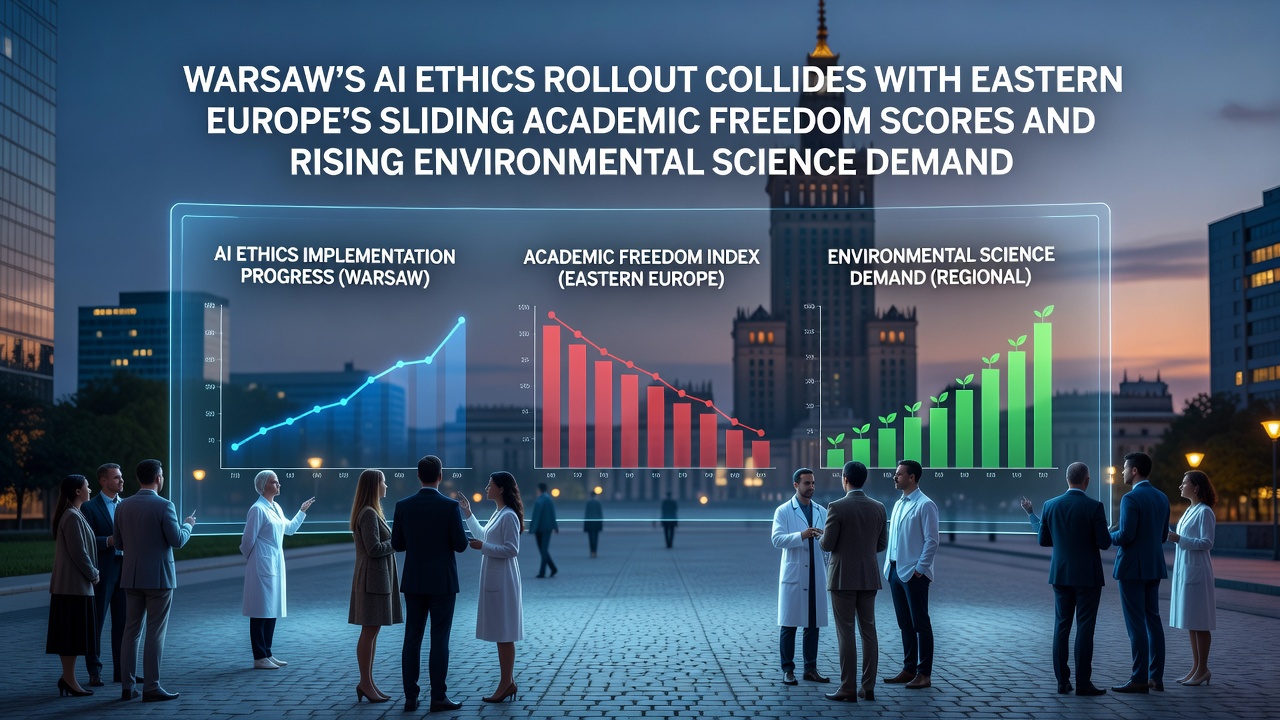
Warsaw launched its AI ethics framework in early 2025 wth municipal guidelines that require transparency audits for public sector algorithms, yet implementation has run into resistance as Eastern European academic freedom metrics continue their downward trend through 2026. Data from monitoring organizations show Poland, Hungary, and Romania posting the steepest declines in university autonomy scores between 2023 and 2025, while environmental science enrollment across the region rose 18 percent in the same period according to higher education statistics compiled by the European Tertiary Education Register.
AI Ethics Framework Meets Institutional Constraints
The Warsaw program mandates impact assessments for AI tools used in city services such as traffic management and public health monitoring, and it requires documentation of training data sources plus bias testing protocols. City officials rolled out training workshops for municipal staff in March 2026, but several university departments that had been slated to provide independent review teams reported staffing shortfalls. Researchers at institutions in Warsaw and Krakow cited funding freezes and administrative reviews as reasons they could not commit personnel, conditions that align with broader Eastern European patterns documented in academic freedom reports released by the European University Association.
Academic Freedom Metrics Show Regional Decline
Freedom House and Scholars at Risk tracking data indicate that Eastern European countries lost an average of 12 points on composite academic freedom indices from 2020 to 2025, with restrictions on curriculum content and researcher travel cited most frequently. In September 2026 the European Commission published updated figures showing continued pressure on social science and humanities faculties, fields that often intersect with AI ethics review panels. Universities in the region responded by shifting resources toward applied environmental programs, where external grants from EU climate initiatives have remained stable or increased.

Environmental Science Demand Continues Upward Trajectory
Enrollment in environmental science and sustainability degree programs across Poland, the Czech Republic, and Slovakia increased from 41,000 students in 2022 to nearly 49,000 in 2025, according to national statistical offices. Employers in renewable energy, water management, and urban planning have posted rising numbers of vacancies that list data analytics and modeling skills, competencies that overlap with AI toolsets. Several Warsaw technical universities therefore redirected faculty lines toward joint environmental-AI curricula, leaving fewer experts available for standalone ethics oversight roles demanded by the city framework.
Points of Friction in Policy Implementation
City procurement documents from June 2026 reveal that three AI ethics review contracts originally awarded to academic consortia were later reassigned to private consultancies after universities cited internal governance reviews that delayed project start dates. Observers note that these delays coincide with national legislation passed in 2024 that expanded ministerial oversight of university hiring decisions in Poland and Hungary. Environmental science departments, by contrast, secured new laboratory equipment through EU structural funds, illustrating how grant availability shapes institutional priorities when academic freedom conditions tighten.
Cross-Border Research Networks Adapt
Collaborations between Warsaw-based teams and partners in Germany and the Netherlands have continued, though travel funding for Eastern European researchers has faced additional scrutiny at some institutions. A joint project on AI-supported climate modeling launched in April 2026 through the Horizon Europe program includes ethics compliance modules that reference both Warsaw municipal rules and broader EU AI Act requirements. Project coordinators report that participating universities balanced these obligations by embedding environmental data specialists who already work under grant conditions that require open-access outputs, a structure that reduces some administrative friction.
September 2026 Developments
During September 2026 the Warsaw city council held its second annual AI ethics stakeholder forum, where representatives from environmental research institutes presented case studies on using machine learning for flood prediction while noting limited capacity to also conduct bias audits. Forum transcripts indicate that participants requested clearer delineation between municipal ethics requirements and existing national research ethics boards, a distinction that has grown sharper as academic governance structures face ongoing adjustments. Registration numbers for the forum increased 22 percent from the previous year, reflecting heightened interest from environmental science students entering the workforce.
Conclusion
Warsaw's AI ethics rollout therefore operates within a regional context where academic freedom indicators have declined while demand for environmental science expertise has grown. Institutional responses include reallocation of faculty effort, increased reliance on private sector reviewers, and selective participation in cross-border projects that align with available funding streams. Data released through 2026 show these patterns persisting without immediate reversal, shaping how ethics frameworks intersect with research capacity across Eastern Europe.